

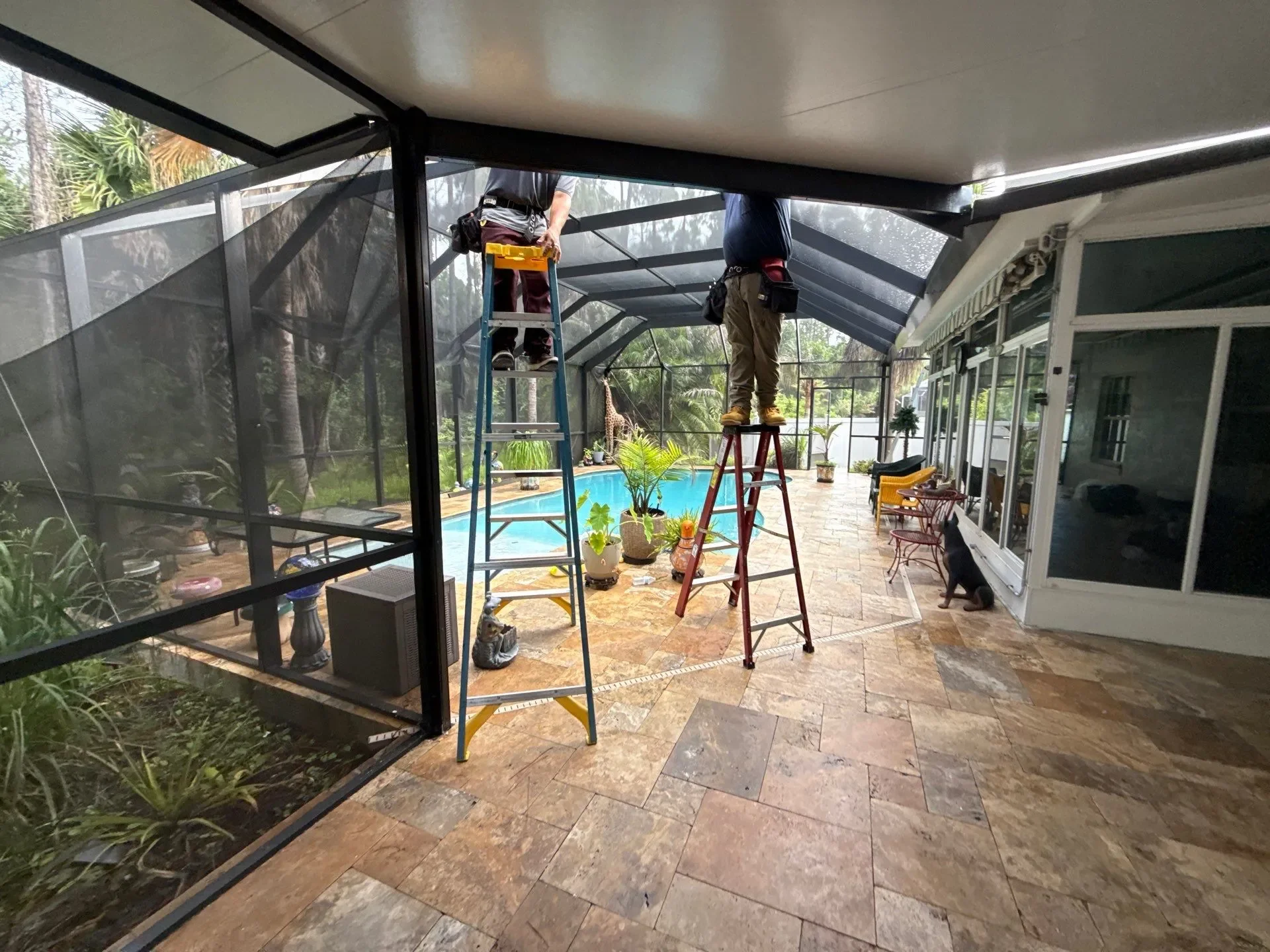
If your Florida pool cage has torn screens, loose panels, or visible wear, should you rescreen it or replace the entire enclosure? Rescreening is usually the better option when the aluminum frame remains structurally sound, while replacement deserves consideration when the frame has widespread corrosion, damage, or other structural problems. A professional inspection can help determine which option makes sense for your property and budget.
Florida's heat, humidity, salt air, heavy rain, and seasonal storms can take a toll on pool enclosures. However, damaged screen mesh doesn't automatically mean the entire structure needs to go. Understanding the difference between screen wear and frame deterioration can help you avoid unnecessary expenses while addressing problems that could become more serious.
What Does Pool Cage Rescreening Involve?
Pool screen rescreening involves removing worn or damaged mesh and installing new screen material in the existing enclosure. Depending on the condition of the structure, a contractor may replace individual panels or rescreen a larger portion of the cage.
This option is often suitable for homeowners whose frames remain stable but whose screens have deteriorated over time.
What Does the Process Include?
A typical rescreening project may involve:
Inspecting the enclosure and identifying damaged panels.
Removing old screen material and deteriorated spline, the flexible cord that holds the mesh in its frame.
Checking the screen channels and surrounding frame components.
Installing new screen material and securing it properly.
Inspecting the finished panels for fit, tension, and visible defects.
The exact scope depends on the enclosure's design, height, screen type, and existing condition.
When Is Rescreening a Good Choice?
Rescreening may be appropriate when the aluminum frame is stable, connections are intact, and most of the damage is limited to the mesh.
Common examples include screens torn by pets, small holes caused by debris, stretched panels, and widespread fading or brittleness after years of sun exposure.
You may also consider rescreening if several panels have failed around the same time but the rest of the structure remains in good condition.
Before proceeding, ask the contractor to inspect the entire enclosure rather than focusing only on the visible tears. A new screen won't correct a loose connection, damaged support, or corroded frame.
What Does Full Pool Cage Replacement Involve?
Pool cage replacement involves removing an existing enclosure, or a substantial portion of it, and constructing a new structure. The work can be more extensive than rescreening because it may involve framing, connections, anchoring, engineering, and permitting.
Replacement is worth evaluating when the enclosure has problems that go beyond the screen mesh.
What Can a Replacement Project Include?
Depending on the project, the work may involve:
Assessing the existing enclosure and documenting its condition.
Removing the old screen panels and structural components as required.
Evaluating the attachment points and supporting surfaces.
Designing a replacement enclosure for the property.
Selecting appropriate framing, screen materials, and roof configuration.
Completing applicable engineering, permitting, construction, and inspections.
A replacement may also give homeowners an opportunity to reconsider the enclosure's layout, screen type, or overall appearance.
When Should You Consider Replacement?
Replacement may be the better long-term option when corrosion affects important structural components, framing is significantly bent or damaged, connections are compromised, or the existing enclosure needs extensive repairs across multiple areas.
It may also make sense when the structure has recurring problems and repairing one section would leave other deteriorated components in place.
However, replacement shouldn't be recommended solely because an enclosure looks old. Age, appearance, and screen condition are only part of the decision. The frame's actual condition and the extent of necessary repairs matter more.
Why the Frame Inspection Is the Most Important Step
The frame is the deciding factor in the rescreen-versus-replacement decision. Screen mesh can be replaced, but new mesh cannot restore the strength of damaged aluminum framing or failing connections.
Aluminum is commonly used in Florida screen enclosures because it performs well in humid conditions, but it is not immune to deterioration. Surface discoloration doesn't always indicate structural failure, and corrosion can vary significantly from one area to another.
What Should a Contractor Inspect?
A professional assessment should consider the following:
1. Corrosion and material condition
The contractor should examine the frame, joints, fasteners, and connection points for corrosion, pitting, deterioration, or other signs of damage. Coastal properties may experience greater exposure to salt-laden air, making regular inspection particularly important.
2. Frame alignment and visible deformation
Bent members, sagging sections, or changes in alignment may indicate damage that needs further evaluation. The contractor should determine whether the issue is cosmetic, repairable, or potentially structural.
3. Connections and anchoring
The enclosure's joints, fasteners, base connections, and attachment points should be checked for looseness, deterioration, or damage. These components help the structure transfer loads safely.
4. Roof supports and larger spans
Roof sections and long framing members deserve attention because damage in these areas may affect a substantial portion of the enclosure. Homeowners should not climb onto the cage to inspect them.
5. Existing repairs and recurring failures
Previous repairs can provide useful context. If the same area repeatedly develops problems, the contractor should investigate the underlying cause rather than simply replacing the visible screen.
How Does a Professional Inspection Work?
A professional inspection generally begins with a visual assessment of accessible framing, screens, connections, and anchoring points. The contractor may document damaged areas, take measurements, and determine whether additional technical evaluation is necessary.
If the condition of a structural component is uncertain, further assessment by an appropriately qualified professional may be needed. An ordinary visual inspection should not be presented as an engineering certification.
The result should be a clear explanation of which components can remain, what needs repair, and whether replacing the enclosure is a more reasonable option.
Rescreening vs. Pool Cage Replacement: Side-by-Side Comparison
Main purpose: Rescreening replaces worn mesh. Full replacement replaces the enclosure or major structure.
Best condition: Rescreening suits a cage whose frame is sound. Full replacement suits a frame that is extensively damaged or unsuitable to retain.
Typical cost: Rescreening is lower. Full replacement is higher.
Project scope: Rescreening covers screen panels and related components. Full replacement involves removal, framing, construction, and related work.
Timeline: Rescreening is usually shorter. Full replacement is usually longer.
Disruption: Rescreening is generally limited. Full replacement is generally more extensive.
Design changes: Rescreening offers limited options. Full replacement offers more opportunities for redesign.
Structural correction: Rescreening does not fix a failing frame. Full replacement can address structural problems through a properly designed project.
Lifespan: For rescreening, it depends on the mesh, exposure, and installation. For full replacement, it depends on materials, construction, maintenance, and environment.
Permitting: For rescreening, it depends on the actual scope and local rules. For full replacement, permit and engineering review are commonly relevant.
Which Option Costs Less?
Rescreening generally costs less because it retains the existing frame and avoids much of the demolition and reconstruction involved in replacement.
However, the lowest initial quote isn't necessarily the best value. If the frame has significant deterioration, investing in new mesh without addressing the underlying problem may lead to additional work later.
Replacement typically involves a larger investment, but it may be more sensible if extensive frame repairs would otherwise be required.
Ask for an itemized estimate that explains the work included, materials, repairs, and any applicable permitting or engineering expenses. Compare the same scope of work across quotes.
How Long Does Each Option Take?
Rescreening is usually the quicker project, especially when the frame is accessible and the work involves standard panels. A large or tall enclosure, specialty mesh, difficult access, or extensive repairs can increase the time required.
Replacement typically takes longer because planning, material preparation, removal, construction, and inspections may all be involved. Permit review, weather, contractor scheduling, and project complexity can affect the overall timeline.
Request a project-specific schedule rather than relying on a general estimate.
Which Option Lasts Longer?
The lifespan of new screen mesh depends on its material, quality, installation, exposure, and maintenance. A replacement enclosure introduces new structural components, but that does not mean every replacement automatically lasts longer than a well-maintained existing cage.
The key is to compare the expected condition of the retained frame and new screens against the condition and design of a replacement structure.
A Quick Decision Checklist
Consider rescreening if:
The aluminum frame appears stable and has no significant structural damage.
Most problems involve torn, faded, loose, or brittle mesh.
Connections and anchoring appear sound.
A contractor confirms that the existing structure is suitable to retain.
Consider replacement if:
Corrosion affects important structural members or connections.
The frame has substantial bending, damage, or deterioration.
Multiple structural components need extensive repairs.
The existing enclosure is unsuitable to retain after professional evaluation.
If you notice both damaged screens and potential frame deterioration, arrange an inspection before choosing either option.
Planning Your Pool Cage Project in Florida
Before starting work, confirm the scope, materials, estimate, project schedule, and responsibilities for permits and inspections.
Permit requirements depend on the work being performed and the jurisdiction where the property is located. A complete enclosure replacement commonly requires a building permit, while the requirements for screen-only work may differ. Check with the relevant local building department rather than assuming that all rescreening or repairs are exempt.
Courtesy Screening's screen enclosure services provide a starting point for discussing your project. Ask whether your enclosure can reasonably be retained, which components require attention, and whether additional technical review is necessary.
Our Recommendation Framework
A practical rescreen-versus-replacement decision should follow three steps:
Assess the frame. Determine whether the aluminum structure, connections, and anchoring are suitable to retain.
Define the scope. Identify whether the problem is limited to the mesh or extends to framing and structural components.
Compare long-term value. Consider the cost of the recommended work, the expected condition of the remaining structure, and the likelihood of further repairs.
This approach helps homeowners make a decision based on the actual enclosure rather than age or appearance alone.
Contact us today to request an inspection and project estimate.
The right recommendation should explain what can be retained, what needs attention, and which option makes the most sense for your property.
Frequently Asked Questions
Can I rescreen a pool cage with a rusted frame?
Possibly, but the type and extent of the deterioration must be assessed first. Aluminum doesn’t rust the way iron or ordinary steel does, so orange-brown corrosion may involve steel fasteners or other metal components. White deposits, pitting, and material loss also need investigation. If important structural components are compromised, rescreening alone may not be appropriate. Ask your contractor for an on-site inspection of the frame, fasteners, and connections before you agree to a rescreen quote.
How long does pool cage rescreening take?
It depends on the enclosure’s size, height, accessibility, screen type, and the amount of work involved. Straightforward projects generally take less time than extensive or complex jobs. Ask your contractor for a schedule based on an inspection, and confirm whether weather or material lead times could affect the start date.
Does replacing a pool cage require a permit in Florida?
A full enclosure replacement commonly requires a permit, but requirements and documentation vary by jurisdiction and project scope. Confirm the current rules with your local building department and contractor before work begins. Ask who will pull the permit and handle inspections, so it’s clear before you sign.
Does rescreening a pool cage require a permit?
Often not, when you’re only replacing screen in an existing, sound enclosure. Changing the frame, roof, or structure is a different matter and usually does. Rules vary by city and county, so check with your local building department or ask your contractor how it works in your area.
How do I know if my pool cage needs rescreening or full replacement?
Look at the frame first. Rescreening makes sense when the structure is sound and only the screen is torn, faded, or sagging. Widespread corrosion, bent or cracked members, loose connections, or failing anchors point toward repair or replacement. A professional inspection can tell you which applies and give you a written scope either way.
What type of screen should I choose when rescreening?
It depends on what bothers you most. Standard screen works for general use, tighter mesh helps with small insects, and specialty options can add sun control or pet resistance. Compare screen types side by side with your contractor and ask how each one affects airflow, visibility, and cost.
